Tamás Nagy presents affective science research at ELTE’s Experience Sampling event
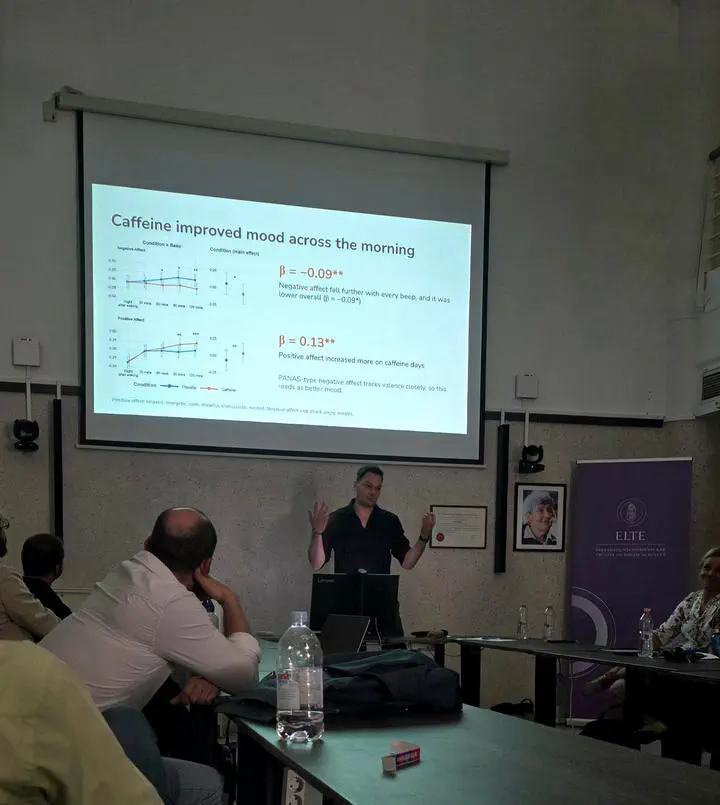
On 30 September 2026, Tamás Nagy gave a talk at From Real-Time Experience to Real-World Impact: Experience Sampling Research at ELTE, held at ELTE’s Lágymányosi Campus in Budapest.
His presentation, titled “Affective science experimentation in daily life,” introduced findings from the study “Caffeine-induced physiological manipulation influences emotions, impulsivity, and affect dynamics in daily life,” co-authored with fellow lab members Levente Rónai and Mercédesz Tóth.
The study combines experimental control with experience sampling methodology to investigate how changes in physiological arousal influence emotions in everyday life. In a randomized, triple-masked, placebo-controlled study, participants received either caffeine or a placebo on different days while repeatedly reporting their arousal, mood, anxiety, impulsivity, and daily experiences.
The presented findings showed that caffeine successfully increased subjective arousal. It was also associated with higher positive affect and impulsivity, lower negative affect, and reduced negative emotional inertia and reactivity. The results illustrate how experimental manipulations can be integrated into experience sampling research to investigate causal processes without removing participants from their everyday environments.
The event brought together experience sampling projects conducted across ELTE and highlighted how intensive longitudinal methods can connect real-time experiences with questions of real-world psychological importance.
Tamás Nagy
Assistant Professor
My research interests include stress and emotion physiology, machine learning, computational science and improving psychological science.